The English Cosmonaut
Celebrating Helen Sharman’s record breaking spaceflight and the Soyuz TM-12 mission which launched from the Baikonur Cosmodrome on 18 May 1991. Helen spent eight days in space, six of them onboard the Mir Space Station.
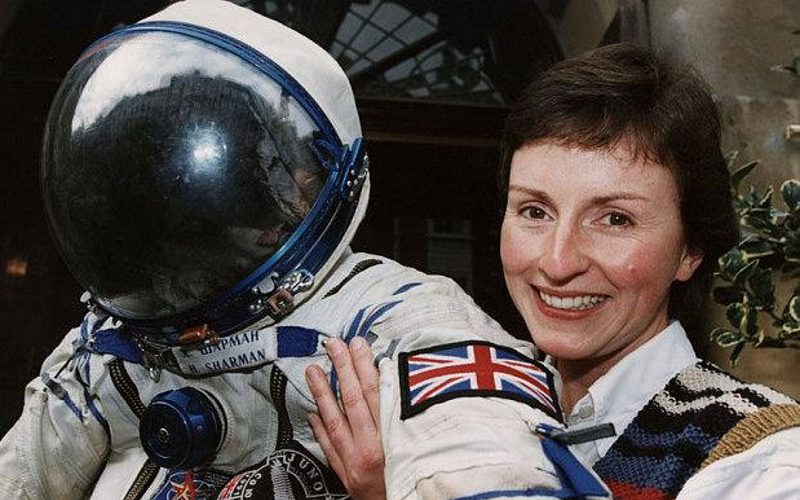
I remember waiting for it to get dark – the Spring Equinox had been and gone and the light had started to linger in the sky well into the evening – and then going out to stand under the stars, hoping I could see the space station as a moving point of luminescence, track it across the heavens somehow. A transient beacon against the greater glow of the Spiral Arm, that tidal wash crammed with a billion suns, a river of cosmic light. Because there was an Englishwoman up there, the first of her kind, up there with two Russian cosmonauts, navigating the orbital shallows in a spaceship that had seen better days.
Once that would have been the stuff of fiction but no more. Call sign, “Ozone 3.” It was easy to imagine the radio hams, crouched over their machines, trying to find the frequency on their homemade sets so they could speak with the cosmonauts, and one cosmonaut in particular. What was it like being in space? What was it really like?
Tired of the predictable headlines – “the girl from Mars” (Mars as in the confectionary company she worked for) – I tried to invent some of my own, but nothing topped the bare essential facts. The startling realisation that an Englishwoman was in space. If she was not quite from the Shires (she had made a home for herself in Surbiton after an upbringing in Sheffield) it was close enough. So did she miss the English wood and the Anglo Saxon weald, the forest streams and the chalk river beds with their nutrient-rich currents – the haunt of the emerald kingfisher and the steel jawed pike, of the dusky owl and the velvety vole. The sterile space station with its iron bulkheads so like a prison of sorts; she wouldn’t be able to leave in the return-capsule until her time was up, until they pried open the hatch to the machine that would be her ride home; the circular hatch like a round portcullis that held the lifeless vacuum at bay.
Then I would be able to follow her down in the news feeds, maybe not in real time but close enough. The space traveller safely back on solid ground, the capsule like a diving bell washed up on the endless plains – on the dry ocean bed – of the Kazakhstan steppes. But changed, surely changed, by the experience. So maybe the girl from Mars after all, like Bowie and his Helter Skelter plunge to Earth in that movie they made back in the Seventies. The extraterrestrial who would now walk amongst us, the first of her kind back down from the stars.


Comments